
Overview
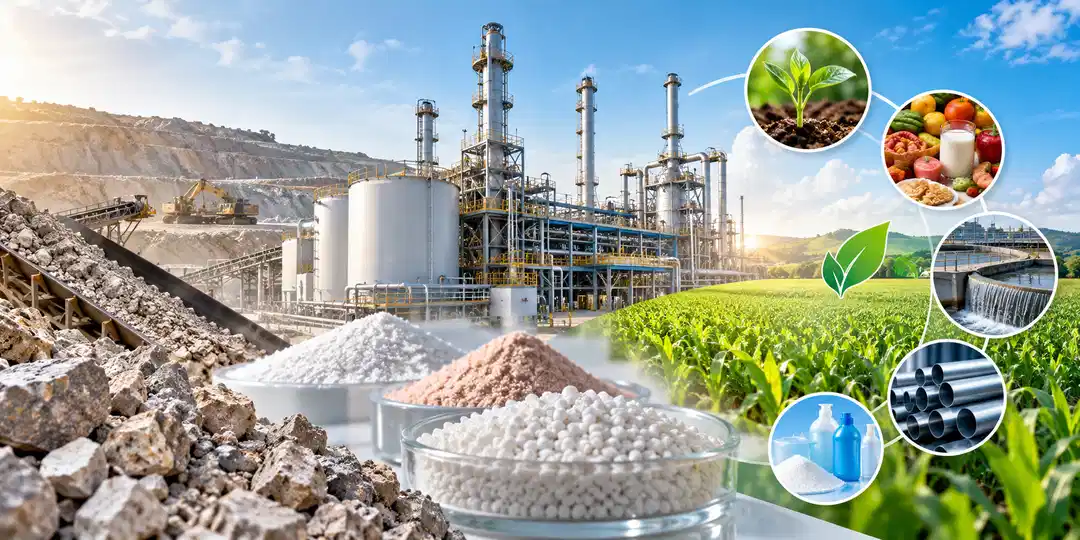
The phosphorus chemicals industry is an essential sector in global manufacturing, supporting agriculture, food processing, water treatment, and various industrial applications. From phosphoric acid and phosphate fertilizers to specialty phosphorus compounds, the industry plays a critical role in improving agricultural productivity, supporting food production, and enabling industrial chemical processes.
Phosphorus chemicals are primarily derived from phosphate rock, which is processed through chemical or thermal methods to produce phosphoric acid, elemental phosphorus, and various phosphate compounds. The properties and applications of these products depend on their chemical composition, purity, processing methods, and intended industrial use. Phosphorus-based chemicals contribute to fertilizer production, food processing, metal treatment, water treatment, and other specialized manufacturing processes.
As global demand for efficient agricultural production and sustainable industrial solutions continues to grow, the phosphorus chemicals industry is evolving through improved production technologies, responsible phosphate resource management, phosphorus recovery and recycling, and more efficient chemical processing methods that help reduce environmental impact while maintaining product quality.
Phosphorus vs. Phosphate
Aspect | Phosphorus | Phosphate |
|---|---|---|
Chemical Nature | Chemical element (P) | Compounds or ions containing the phosphate group (PO₄³⁻) |
Main Forms | White, red, and black phosphorus | Phosphate salts, minerals, and related compounds |
Main Uses | Chemical intermediates and specialty chemical manufacturing | Fertilizers, food additives, water treatment, and industrial applications |
Chemical Stability | Varies by allotrope; white phosphorus is highly reactive | Generally more stable in many common phosphate compounds |
Industrial Importance | Used as a starting material for producing selected phosphorus chemicals | Widely used in agriculture, food processing, and industrial manufacturing |
Common Examples | White phosphorus, red phosphorus | Trisodium phosphate, monocalcium phosphate, diammonium phosphate |
Raw Materials and Phosphorus Chemicals
The primary raw material used in phosphorus chemical production is phosphate rock, a naturally occurring mineral resource containing phosphorus-bearing compounds. Phosphate rock is typically extracted through mining operations and processed to produce phosphoric acid, phosphate fertilizers, and other phosphorus-based chemicals. The composition, phosphorus content, and impurity levels of phosphate rock influence its suitability for different industrial applications.
In addition to phosphate rock, phosphorus chemical manufacturing depends on various processing materials and chemical reagents. Sulfuric acid is widely used in the wet-process production of phosphoric acid, where it reacts with phosphate rock to produce phosphoric acid and calcium sulfate by-products. Thermal processing methods are also used to produce elemental phosphorus, which serves as a raw material for selected specialty phosphorus compounds.
Further processing of phosphoric acid enables the production of phosphate salts and other chemical derivatives used in agriculture, food processing, water treatment, and industrial manufacturing. Ammonia is used to produce ammonium phosphate fertilizers, while sodium and potassium compounds are used to manufacture phosphate salts for specialized applications. Product quality, purity, and chemical composition are carefully controlled according to the requirements of each industry.
Main Raw Materials and Chemical Compounds
Material | Main Function | Application |
|---|---|---|
Phosphate Rock | Primary source of phosphorus | Phosphoric acid and fertilizer production |
Sulfuric Acid | Reacts with phosphate rock to produce phosphoric acid | Wet-process phosphoric acid manufacturing |
Phosphoric Acid | Intermediate for producing phosphate derivatives | Fertilizers, food processing, and industrial chemicals |
Ammonia | Reacts with phosphoric acid to produce ammonium phosphates | MAP and DAP fertilizer production |
Sodium Compounds | Used to manufacture sodium phosphate salts | Food processing, cleaning products, and water treatment |
Potassium Compounds | Used to manufacture potassium phosphate salts | Fertilizers, food processing, and industrial applications |
Elemental Phosphorus | Raw material for selected specialty phosphorus chemicals | Specialty chemicals and industrial manufacturing |
Phosphorus Chemicals Production Process
The phosphorus chemicals production process begins with the extraction and preparation of phosphate rock, the primary raw material used in manufacturing various phosphorus-based compounds. The mined phosphate rock is crushed, screened, and beneficiated to improve its phosphate concentration and remove impurities. The prepared material is then processed through different chemical or thermal methods, depending on the desired end product.
In the wet-process method, phosphate rock reacts with sulfuric acid to produce phosphoric acid, while calcium sulfate is generated as a by-product. The resulting phosphoric acid is separated, filtered, and concentrated to meet specific industrial requirements. Alternatively, thermal processing uses phosphate rock, silica, and carbon at high temperatures to produce elemental phosphorus, which can be further processed into specialty phosphorus compounds.
Further manufacturing stages involve chemical reactions, purification, concentration, and formulation to produce phosphate fertilizers, phosphate salts, and other industrial phosphorus chemicals. Quality control is essential throughout production, including monitoring chemical purity, phosphorus concentration, impurity levels, moisture content, and compliance with applicable industry standards. Efficient production methods help maintain consistent product quality while minimizing waste, energy consumption, and environmental impact.
General Production Flow
Phosphate rock extraction and preparation
Crushing, screening, and beneficiation
Chemical processing (wet-process acid production or thermal phosphorus production)
Separation, filtration, and purification
Chemical conversion into phosphate compounds and derivatives
Quality testing, finishing, and packaging
Applications of Phosphorus Chemicals
Phosphorus chemicals are widely used across various industries, supporting agriculture, food processing, water treatment, and industrial manufacturing. In the agricultural sector, phosphate fertilizers such as monoammonium phosphate (MAP) and diammonium phosphate (DAP) provide essential phosphorus nutrients that support plant growth, root development, and crop productivity.
In the food processing industry, food-grade phosphates are used as acidity regulators, stabilizers, emulsifying salts, and leavening agents in various food products. Water treatment applications include phosphate-based chemicals used for corrosion control and scale management, while industrial manufacturing relies on phosphorus compounds for metal surface treatment, specialty chemical production, and selected flame-retardant formulations.
The versatility of phosphorus chemicals, combined with their importance in agricultural productivity and industrial processes, makes them essential components of global supply chains. Advances in responsible phosphate resource management, recycling technologies, and efficient chemical processing continue to support more sustainable industrial applications.
Key Application Segments
Industry | Main Use | Key Requirement |
|---|---|---|
Agriculture | Phosphate fertilizers, including MAP, DAP, and superphosphates | Nutrient content, solubility, and consistent quality |
Food Processing | Acidity regulators, stabilizers, emulsifying salts, and leavening agents | Food-grade purity, safety, and regulatory compliance |
Water Treatment | Corrosion control and scale management | Controlled dosing, chemical compatibility, and treatment efficiency |
Industrial Manufacturing | Metal surface treatment and specialty chemical production | Chemical purity, concentration, and process compatibility |
Flame Retardants | Phosphorus-based flame-retardant additives for plastics, coatings, and textiles | Thermal performance, material compatibility, and applicable safety standards |
Safety, Handling and Storage
Phosphorus chemicals require careful handling and storage to ensure workplace safety, product quality, and environmental protection. Different phosphorus compounds, including phosphoric acid, phosphate salts, and elemental phosphorus, have distinct chemical properties and safety requirements. Appropriate personal protective equipment (PPE), proper ventilation, and safe handling procedures are essential to minimize exposure risks and prevent chemical incidents.
Phosphoric acid should be stored in compatible, corrosion-resistant containers, away from incompatible substances. Phosphate salts should generally be kept in dry, well-ventilated environments to prevent moisture absorption, contamination, and product degradation. Elemental phosphorus requires specialized storage and handling procedures, particularly white phosphorus, which can ignite spontaneously in air and must be stored under appropriate controlled conditions.
Dust control, chemical segregation, and spill prevention are important considerations in phosphorus chemical handling facilities. Regular equipment inspections, employee training, and compliance with applicable safety regulations help maintain safe operations throughout the supply chain.
General Handling Principles
Store phosphorus chemicals according to their specific chemical properties and Safety Data Sheet (SDS) requirements.
Use appropriate personal protective equipment (PPE), including chemical-resistant gloves, protective clothing, and eye protection.
Maintain adequate ventilation and dust control systems in chemical handling and storage areas.
Keep chemicals away from incompatible substances, heat sources, and potential ignition hazards, as applicable.
Ensure proper labeling, chemical segregation, and access to emergency response equipment.
Follow manufacturer instructions, applicable safety regulations, and Safety Data Sheet (SDS) guidance.
Storage Overview
Material Type | Recommended Storage Conditions | Main Consideration |
|---|---|---|
Phosphate Rock | Store in designated areas with appropriate moisture and dust control | Prevent contamination and minimize dust exposure |
Phosphoric Acid | Store in compatible, corrosion-resistant containers with appropriate containment | Prevent corrosion, leaks, and chemical exposure |
Phosphate Salts | Store in dry, well-ventilated areas in properly sealed containers | Prevent moisture absorption and contamination |
Elemental Phosphorus | Store under specialized, substance-specific conditions; white phosphorus requires protection from air | Prevent ignition, chemical reactions, and exposure hazards |
Phosphorus-Based Specialty Chemicals | Follow product-specific SDS requirements for temperature, ventilation, and segregation | Maintain chemical stability and safe handling |
Sustainability and Innovations
The phosphorus chemicals industry plays an important role in sustainable agriculture, resource management, and industrial development. As phosphate rock is a finite natural resource, responsible sourcing, efficient processing, and effective phosphorus management are essential for reducing environmental impact and ensuring long-term resource availability.
Manufacturers are increasingly exploring energy-efficient production technologies, improved waste management practices, and phosphorus recovery systems to enhance environmental performance. Recovering phosphorus from wastewater, sewage sludge, and agricultural waste can help reduce dependence on mined phosphate resources while supporting circular economy initiatives. Improved fertilizer application methods and nutrient management practices also contribute to reducing phosphorus losses and minimizing water pollution.
Innovation in the phosphorus chemicals industry includes advanced phosphate recovery technologies, controlled-release fertilizers, high-purity phosphorus compounds, and more efficient chemical processing methods. As demand for sustainable agricultural solutions and responsible industrial practices grows, the phosphorus chemicals industry is expected to play an increasingly important role in resource efficiency, environmental protection, and circular economy development.